 Timber industry research & analytics
 Estonian timber entrepreneur accuses listed giant Stora Enso of a transaction damaging shareholders’ interests
One of the wealthiest entrepreneurs in Lääne-Virumaa, Tarmo Noodla, is heading to Stora Enso’s shareholder meeting in Helsinki tomorrow with a question that has so far remained unanswered: why was he, as the highest bidder, pushed aside just before the purchase agreement for the Näpi sawmill was concluded in a situation where all other transaction conditions were the same.
Estonian timber entrepreneur Tarmo Noodla accuses the Swedish-Finnish forestry giant Stora Enso of a transaction damaging shareholders’ interests. When Noodla attempted to purchase the Näpi sawmill from Stora Enso, his higher offer through Leventek OÜ was rejected in favor of the French-owned company Puidukoda. Noodla, who is now a minority shareholder of Stora Enso, demands answers at the shareholders’ meeting. He claims that a competitive advantage may have been kept secret and accuses discrimination because he is an Estonian entrepreneur. Stora Enso rejects all accusations, saying that strict business principles and transparency were followed.
Left outside the gate of the Näpi sawmill. Stora Enso minority shareholder and entrepreneur who was interested in purchasing the Näpi sawmill, Tarmo Noodla, wants to inform other shareholders, in light of future transactions, that the Näpi purchase and sale transaction did not comply with good business practice and commercial reasoning, and that Stora Enso suffered significant damage during the transaction. To convey his message, he has prepared a poster.
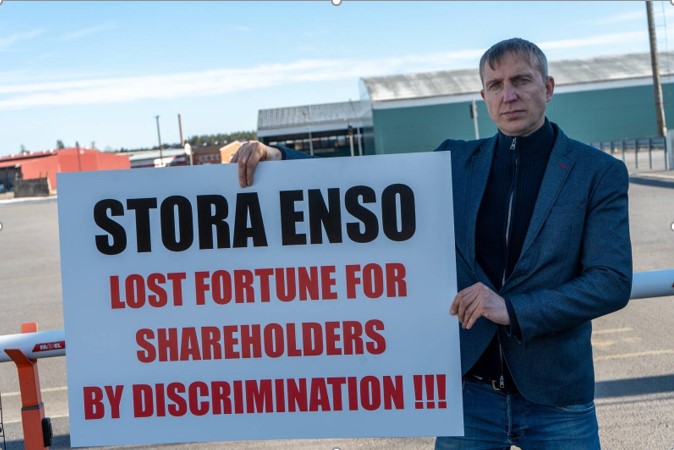
“Business should not be conducted this way, especially when dealing with a Scandinavian listed company, because pushing aside a competing and higher-priced offer does not represent the best interests of shareholders,” Noodla expressed his disappointment, recalling events that by now date back more than two years.
His emotions have not subsided to this day, and after the failed transaction, Noodla, who purchased Stora Enso shares, is trying to obtain explanations from the large corporation already as a minority shareholder.
He has prepared for tomorrow’s Stora Enso general meeting of shareholders and hopes that by publishing his story in advance, this will force the corporation’s management to provide explanations.
So far, all his attempts to raise the issue have simply faded away, and Stora Enso’s internal control has also refused to carry out an investigation.
Stora Enso
Stora Enso was created in 1998 as a result of the merger of the Finnish company Enso Oyj and the Swedish company Stora Kopparbergs Bergslags Aktiebolag (STORA). The group is a leading global producer of recyclable packaging, biomaterials and wooden constructions, and one of the largest private forest owners.
As of the end of last year, Stora Enso had over 100,000 shareholders. The group’s shares are listed on the Stockholm and Helsinki stock exchanges.
Under the Stora Enso brand, the Imavere sawmill operates in Estonia. Stora Enso’s companies in Estonia employ approximately 550 people in total.
“If the seller’s arguments and actions during negotiations are convincing, then I accept the transaction, but to this day I do not understand Stora Enso’s behavior and why such a decision was made,” said Noodla.
Wanted to buy the Näpi sawmill
The story began in early summer 2023, when Stora Enso announced the closure of the sawmill located in Näpi near Rakvere and the plan to sell the complex. For Noodla, who has spent his entire working career in various wood-processing companies and owns the successful company Leventek OÜ in the field, the news immediately caught his attention: “because the timber industry is my hobby and passion.”
Näpi is connected to him through his work years ago at the then Britannic sawmill, and Noodla, who seized the opportunity from Stora Enso’s announcement, contacted the large corporation. Negotiations lasting months began, during which the terms of the purchase and sale agreement were agreed upon, Leventek offered its initial price of 3.15 million euros, and even the notary time for the transaction was set.
Leventek had sufficient funds, and the purchase would have been financed from its own resources. According to the business plan, the company planned to offer work to 30 people in Näpi. A buyer also existed for the company’s Tamsalu plant.
Leventek OÜ
A wood-processing company operating in Tamsalu, Lääne-Virumaa. In 2024, the company’s sales revenue was 21 million euros and profit nearly one million euros. The company’s equity reached 24 million euros at the end of the same year. There were 22 employees last year.
Leventek’s manager and owner Tarmo Noodla was ranked 200th in the latest Äripäev Rich List with assets estimated at 35 million euros.
According to Noodla, during negotiations he learned from a Stora Enso representative that he was the only interested party for the entire complex, meaning the real estate and equipment (except the saw line).
Then, however, strange things began to happen for Noodla, and Leventek was pushed out of the transaction. Despite the fact that he offered Stora Enso a higher price under the same conditions. (see below correspondence between Noodla and Stora Enso representative – ed.)
Why the listed company no longer responded to his offers and decided to earn less money for its shareholders is something Noodla still does not understand.
A persistent fighter
After missing out on the Näpi sawmill, Noodla acquired Stora Enso shares through Leventek and as a minority shareholder of the group he has many questions. Since Stora Enso has announced a plan to sell its sawmill industries located in Central Europe, Noodla believes that, based on the example of the Näpi sawmill sale, questions arise regarding the competence of the group’s management and adherence to good business practice.
“As one of Stora Enso’s minority shareholders and a participant in the Näpi sawmill transaction, I want to inform other shareholders that this purchase and sale transaction did not comply with good business practice and commercial reasoning, and that Stora Enso suffered significant damage during the transaction,” he said.
Noodla did not rule out that confidential information may have leaked from Stora Enso regarding the terms agreed during negotiations, Leventek’s business plan and their offered price.
The parties had agreed on a confidentiality obligation, according to one clause of which employees of Stora Enso’s affiliated companies were not allowed to be in the information field of the negotiations. Noodla was additionally emphasized in writing that negotiations must take place through Stora Enso headquarters, represented by Katalin Bognar-Simor and Jari Suvanto. It was not allowed to communicate with the local Näpi team regarding transaction conditions.
Nevertheless, on December 11, Bognar-Simor, who led the Näpi sawmill sale project on behalf of Stora Enso, sent Noodla an email, which was also sent as a copy to the then CEO of the Näpi sawmill Anne-Liis Kapstas. The email included previous communication between the parties, from which Leventek’s offered price and other agreements became visible.
The email was a response to a question sent by Noodla, because during the inspection of equipment at the factory it turned out that not all parts were attached to the planing line, although according to the list they should have been.
There is no real basis for the accusation
Stora Enso’s communications manager Liisa Nyyssönen noted that no accusation of breach of confidentiality can be made against Bognar-Simor without real grounds.
After the described possible information leak, events began to develop rapidly. Four days later, on December 15, Noodla received from Stora Enso draft agreements for the purchase of movable and immovable property of the Näpi sawmill.
From the letter he learned that the same package of documents had also been sent to another buyer candidate. The appearance of a competitor was a big surprise for Noodla, and four days later Stora Enso’s representative informed that negotiations had been started with the other party.
Noodla then made desperate offers, stating that he was ready to pay up to 10% more than the other bidder under exactly the same conditions. Just before the notary time he made one more move, raising the purchase price to 4 million euros. Unfortunately, despite promises, no feedback came from Stora Enso and the transaction was concluded with the French-owned Puidukoda OÜ.
Tried to buy it from the new owner
The Näpi sawmill was purchased by Puidukoda OÜ.
Noodla did not give up and contacted the managers of Puidukoda to buy the newly acquired asset from them. As a result of several increasingly higher offers, he was finally ready to pay seven million euros, but Puidukoda was not interested in selling.
Puidukoda CEO Eveli Opmann was surprised that Noodla is raising the issue now.
“Today is the year 2026 and life goes on, sometimes you win and sometimes you lose. A private company can sell its assets to whoever it wants,” she said.
“It was not like we put an offer on the table and made the deal the next day.”
Eveli Opmann
CEO of Puidukoda OÜ
According to Opmann, the purchase and sale process was open and correctly conducted by Stora Enso. Puidukoda negotiated for several months and the final choice was made by the seller. “It was not like we put an offer on the table and made the deal the next day.”
According to the signed agreement, Puidukoda cannot disclose the transaction price. This is also not clearly reflected in the company’s financial reports.
Similarly, Noodla could not determine from Stora Enso Estonia’s financial reports how much money the sale of the Näpi sawmill brought to the corporation.
“In my professional opinion, the transaction has indeed been reported in an extremely complex and non-transparent way, which is strange. With 99% probability, pressure from management,” assessed a financial expert hired by Noodla, whose estimate suggested the expected purchase price could have been up to 3.8 million euros.
Noodla believes that Stora Enso’s internal control does not function for some reason, because contacting it did not bring success. Internal control responded that everything was in order and there is no intention to conduct further investigation.
In addition, Noodla brought forward the discrimination argument. In his opinion, he was pushed out of the transaction because he is a small Estonian entrepreneur, and the course of negotiations points to possible corruption in the private sector.
Stora Enso categorically rejected discrimination claims
Stora Enso’s communications manager Liisa Nyyssönen said that Stora Enso does not disclose detailed financial terms of individual sales transactions unless it is publicly required.
However, Stora Enso categorically rejected any claims of discrimination, stating that all potential buyers in a sales transaction are evaluated based on the same business and legal criteria, regardless of their ownership structure or country of origin.
“These strict governance principles are applied consistently and without exception to all current and future sales transactions,” said Nyyssönen.
Nyyssönen added that in all mergers and acquisitions, Stora Enso bases its decisions on a thorough evaluation of several factors such as value, risk, sustainability, business continuity and certainty of execution – meaning that price is only one of several considerations.
Transactions must follow the business judgment rule
According to Leventek’s lawyer Tarmo Rep, members of the management body of a company must follow the business judgment rule when making transactions, the principles of which have been repeatedly explained by the Supreme Court in its practice.
First, the person must not have a personal interest in the activity. Second, they must be informed to a degree that can reasonably be considered sufficient under the circumstances, and third, a good-faith person acting in a similar situation may rationally believe that their action or decision is in the best interests of the company.
When these principles are followed in making transactions, the interests of the company and shareholders are protected.
Partial excerpt from the final phase of negotiations in 2023:
November 23, Stora Enso: “If we can complete signing and closing as planned: on December 17 – please confirm; from January you will have access to the site and purchased assets. Our lawyers will start working on the agreements, I will share them as soon as they are ready for your review.”
November 24, Noodla: “Thank you for confirming access to the site and assets from January. Signing and closing as planned on December 17, all agreed.”
November 24, Stora Enso: “December 17 – great, I will inform the lawyers to ensure draft documents are ready in advance.”
December 4, Stora Enso: “I noticed that December 17 is Sunday. We read the calendar wrong, apologies. Let’s aim for the 15th, that is Friday.”
December 7, Stora Enso: “I hope to send draft agreements tomorrow so you can begin reviewing. The real estate sale agreement must be signed in front of a notary. Our lawyers can book the appointment, but please share if there is anything about your availability we should consider. Are you potentially available on the 15th? If the 15th does not work with the notary, are you available on the 14th or 18th?”
December 7, Noodla: “14th and 15.12.23 are ok.”
December 13, Noodla: “Any news regarding the 3.15 million euro project with 51 points?”
December 15, Stora Enso: “I am now sending both the APA (asset purchase agreement) and the real estate purchase agreement drafts. I have added comments to parts of the real estate transaction that we still need to change, so you can see what content will be added. We are working on these missing parts and annexes and will share them as soon as possible. Please review and come back as soon as possible with any comments or questions. It would be great to receive your final offer: total amount and comments on the agreements by Monday at 16:00.
As we want to complete this transaction on time and finalize it before Christmas, we have decided to send this “package” (draft agreements and emissions list) to both you and another buyer candidate. We hope to make the final decision on Tuesday. Finalize agreements with the selected buyer on Wednesday and proceed to signing on Thursday, the 21st at 14:00 – this was the available time at the notary, basically the only possibility to complete the transaction this year.”
December 15, Noodla: “My increased offer for boiler house equipment is 200,000 euros. Signing on Thursday the 21st at 14:00 via e-notary or otherwise, I agree with everything.”
December 19, Noodla: “Please provide information regarding your final response.”
December 19, Stora Enso: “We have started negotiations with the other party and will know the final outcome by Thursday. I will contact you then.”
December 20 at 08:59, Noodla: “In the interest of saving jobs in the local timber industry at a difficult time, I wish to offer the same price as the other buyer, plus 5%, plus the same flexible conditions they offer, if that helps.”
December 20 at 21:04, Noodla: “As further proof of our interest in saving jobs in the local timber industry at a difficult time, I wish to increase our offer even further to the same price as the other buyer, plus 10%, plus the same flexible conditions they offer, if that helps. I am also ready to go to the notary immediately to conclude the transaction.”
December 20 at 21:08, Stora Enso: “I appreciate your interest. If I have positive news to share, I will contact you.”
December 21 at 9:11, Noodla: “I am ready to come to the notary. Travel time 1h 45 min. Please confirm and share details with us.”
December 21 at 9:13, Stora Enso: “We plan to proceed with the other buyer. I will let you know if the situation changes.”
December 21 at 11:37, Noodla: “Following is Leventek’s final offer: instead of 3,150,000 eur we increase the offer to 4,000,000 eur and are ready to sign today in Tallinn at 14:00.”